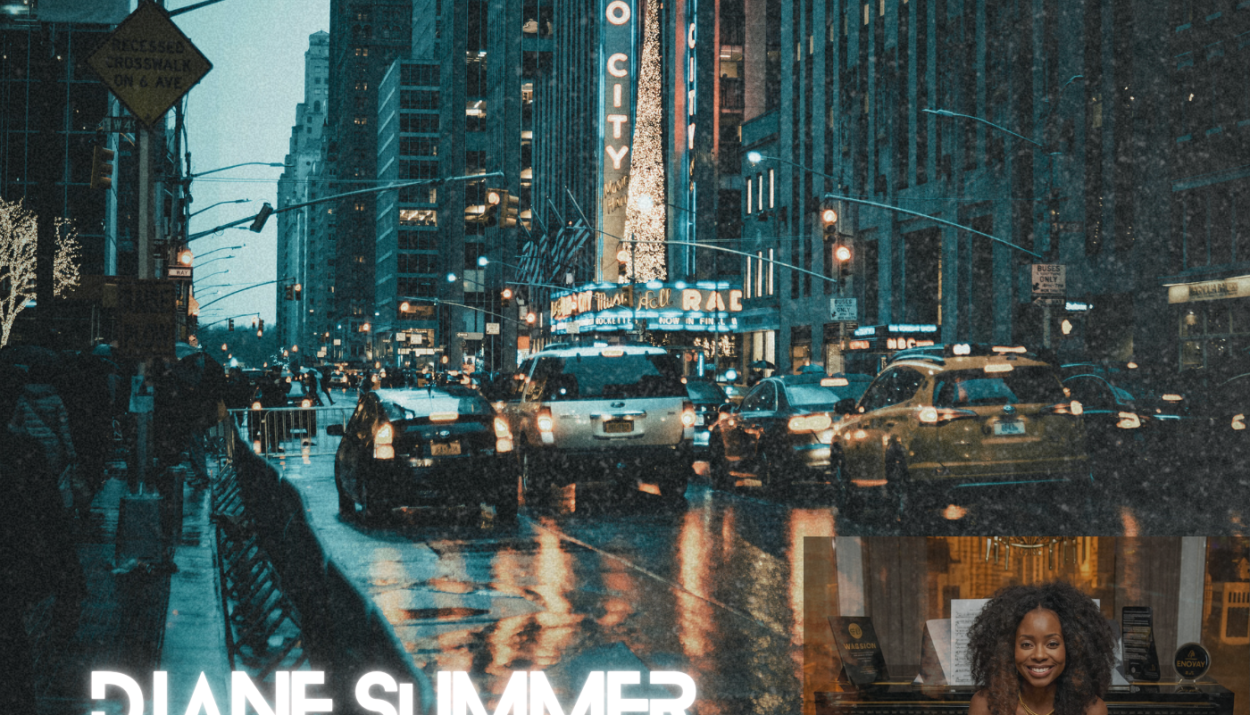

Diane Summer arrives at Urban Solescapes like an artist who has experienced many musical lives and learned to turn pressure into poise. Born in New York and now based in England, she carries a rare blend of soul, jazz sensitivity, and emotional intelligence that makes her voice feel personal before it fully reveals itself. Her songs embody the spirit of a city, yet they never feel cold or mechanical. Instead, they are warm, human, and quietly brave. Produced by Swedish producer Kent B Nyberg, the album, “Urban Solescapes,” feels polished without losing its intimacy, contemporary without blindly following trends, and deeply expressive without becoming excessive. It is the kind of album that doesn’t just play in the room; it changes the atmosphere.
The title “Urban Solescapes” is fitting, as this album constantly discovers beauty in modern solitude. Diane Summer writes from the emotional core of everyday life and gives each feeling a poetic and immediate shape. Her vocals stand out as one of the album’s greatest strengths. She sings with control when needed, with ache when required, and with release when the song calls for uplift. Even at her most intense, she maintains control. This control lends elegance to the album. She doesn’t force emotions on the listener; instead, they arrive naturally, line by line, breath by breath.
The album’s opening stretch showcases Diane Summer’s versatility. “Soul Feeling Free” is a warm, introspective pop track focused on emotional clarity and surrender. The opening line, “Woke up weightless. Sun sneaking in through the blinds,” paints a scene of calm awakening right away, and Summer delivers it with a softness that feels authentic rather than performed. When she sings, “My soul is feeling free. Like open windows. Driving by the sea,” the song opens up with her, and the production—gentle guitars, beautiful piano keys, and light rhythmic textures provides room for that feeling to flourish. It is an understated liberation song, and that subtlety is precisely why it resonates.
Then comes “If I Scream My Name,” which hits like a storm. The song transforms identity into a dramatic, almost mythical force, with lines like “Scream it loud! Tear the sky!” and “If I scream my name” pushing selfhood into apocalyptic territory. Summer’s performance here is fearless. She shifts from raw power in the chorus to a whispered breakdown that suggests the brink of collapse. The industrial-leaning production’s rumbling low-end perfectly matches the emotional weight. It is the album’s most explosive moment, yet it never feels chaotic for its own sake; it feels necessary.
“Shadow World” transitions to a more eerie and contemplative mood. With lines like “The moon’s a spy. It watches close,” the song conjures a sense of uncertainty about reality. Summer sings with a controlled, haunting touch that makes the song feel suspended in fog. The production remains sparse and atmospheric, with reverb-heavy percussion and distant drones that make the whole track resemble a corridor between sleep and waking. The refrain is, “This is the shadow world. Can you see?” It becomes less a lyric than a question hanging in the air. It’s beautiful yet unsettling.
On “Friends Keep Asking,” she turns inward with striking control. This is one of the album’s most quietly heartbreaking songs, capturing the awkwardness of heartbreak from a distance. “Friends keep asking where you are. Like I didn’t watch you walk away” lands with painful honesty, while the line “You’re a ghost in my morning coffee” sticks with you because it feels so emotionally precise. Summer doesn’t exaggerate the hurt; she allows it to linger in the pauses between phrases. Sparse piano, soft ambient pads, and hesitant percussion keep the arrangement emotionally tight, making the ache hit harder.
“Night Is Too Short” brings momentum back into the album. It’s bright, urgent, and cinematic, carried by the sense that time is slipping away. “The night is too short, too short to stay still” serves as a mantra for surrendering to movement and impulse. Summer’s breathy yet commanding delivery lifts the chorus, while pulsing synths and a heartbeat bassline create a feeling of restless forward motion. The track evokes a midnight street glowing under neon, alive with energy. It is one of the album’s most euphoric songs, yet she maintains elegance throughout.
The mood shifts again with “Cool Down,” offering a deep breath after feeling overstimulated. The repeated plea, “Cool me down, cool me down. The phrase “Let the noise just drift into the ground” captures modern exhaustion simply. Lines like “Ice on my forehead” and “Scroll. Stop. Another window” make the song painfully current. Summer’s voice takes on a confessional tone, hovering near the microphone as if she is trying to ground herself in real time. Minimal ambient production, a subdued electronic pulse, and filtered glitches reinforce the sense of mental clutter slowly dissolving into calm. It’s a small song with a significant emotional impact.
“Rewind My Life” ranks among the album’s most moving ballads. The central idea, trying to “press rewind in my life,” is simple and heartbreaking. Summer sings with controlled vulnerability, allowing the weight of the lyric to build naturally. Images like “dust in the sunlight,” “whiskey ring halo,” and “your keys in the door late” provide the song with a cinematic intimacy that feels specific yet universal. Soft piano, ambient textures, and subtle percussion evoke the sensation of memory itself: drifting, blurred, and impossible to control fully.
“Upside Down World” dives into surreal disorientation with lines like “the streets are mirrors, the sky’s the ground” and “I’m walking backwards, lost, not found.” Summer’s voice sounds fragile yet steady, which amplifies the surrounding instability. The production floats and warps beneath her, never completely settling, reflecting the theme of reality slipping out of alignment. This track leaves you feeling slightly off-balance in a positive way.
“Teeth In A Grin” tackles the everyday stress of financial burdens and turns them into something vivid and tangible. “Bills on the counter” and “red letters laughing” sting, while the repeated phrase “teeth in a grin” suggests forced optimism amid stress. Summer’s close-mic delivery lends the song an almost confessional vibe, as if she were sharing her exhaustion directly. The muted piano, soft low-end pulse, and tape-warped percussion create an intimate, claustrophobic atmosphere that perfectly captures the lyric’s sense of ongoing struggle.
With “River In My Head,” the album slows down for introspection again. “Slow like a river in my head” is a striking central image, and the song uses it to explore unresolved thoughts, memories, and emotional drift. Summer’s vocals are breathy and intimate, tracing the melody with the same quiet persistence as the river in the lyric. Sparse, reverb-drenched piano and slow ambient pads create an open, contemplative feel, as if standing beside something that continues to flow even when you remain still.
“Tiny Square” delivers one of the sharpest modern observations on the record. The image of a “tiny square” on a screen symbolizes digital intimacy, distance, and passive observation. “Tap to open” and “Tap to care” strike deeply, revealing how easily feelings are reduced to gestures. Summer’s delivery is understated and conversational, which enhances the loneliness in the song. Minimal electronic textures and faint glitch percussion maintain the track’s cold, screen-lit atmosphere without diminishing its emotional resonance.
The album closes with “While You Sleep Through The Night,” a tender portrait of love expressed through vigilance. “While you sleep through the night” and “I’m here. Working overtime” convey a quiet, anxious devotion that feels deeply human. Summer sings almost as if whispering, and that fragile tone makes the song feel achingly intimate. Soft piano, muted ambient textures, and sparse percussion recreate the stillness of night, while the repeated checking and rechecking in the lyrics transform everyday domestic detail into emotional poetry. It is a beautiful conclusion because it doesn’t resolve everything; it simply honours the act of staying.
As an album, Urban Solescapes succeeds because it embraces nuance. The production from Kent B. Nyberg is clean, spacious, and richly textured without becoming too polished to obscure the human element. The instrumentation moves fluidly between acoustic warmth, electronic atmosphere, jazz-inflected sophistication, and pop clarity. Throughout the record, the arrangements know when to expand and when to pull back. This balance allows Diane Summer’s voice to remain the emotional core at all times.
What lingers most is her delivery. She sings as someone who knows that feelings don’t always have to be loud to be impactful. She can sound intimate, haunted, luminous, or furious. The lyrics are nothing short of superb! Excellent wordplay and very descriptive lyrics that carry Diane Summer’s emotions, supported by Kent B. Nyberg’s excellent production and arrangement.
Listen to the “Urban Solescapes” album on Bandcamp
Follow Diane Summer here for more information