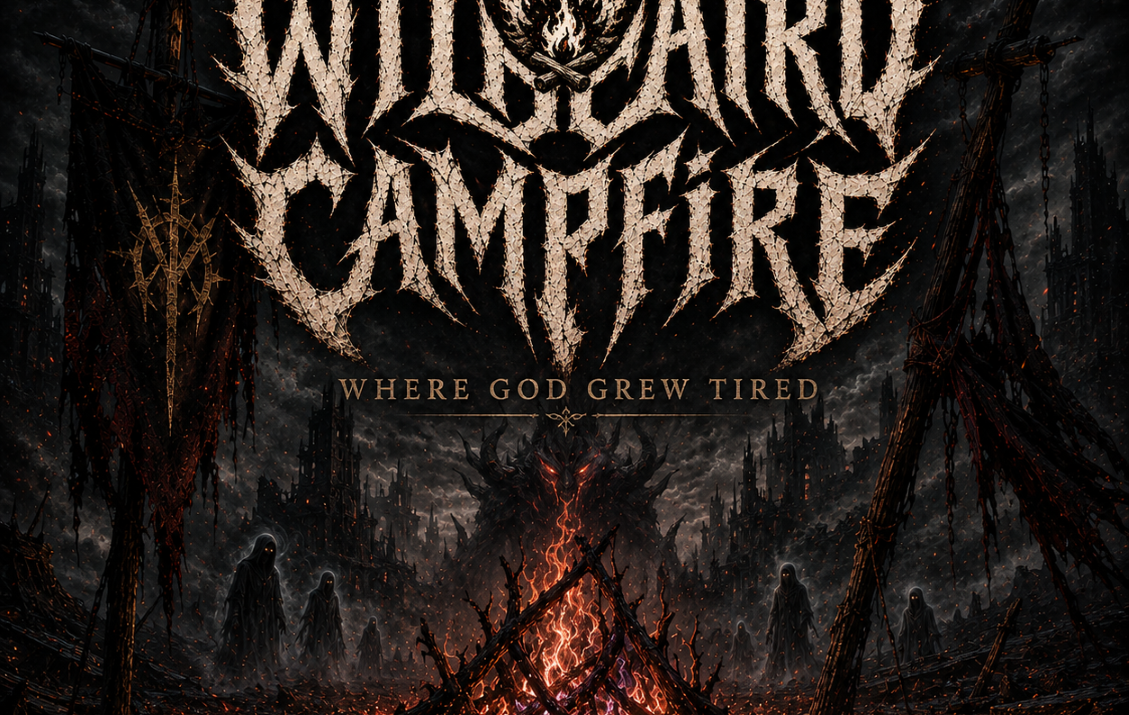

Hi there, prepare to make room for a new storyteller in the world of heavy music. Rising from the shadows with guitars loaded, wild imaginations, and an entire universe of stories waiting to be told, Wildcard Campfire follows unfamiliar maps. This faceless, story-driven project has its mythology, characters, and its way of turning human conflict into sonic fire. Blending melodic metalcore, deathcore, modern metal, and cinematic atmosphere, Wildcard Campfire brings together crushing riffs, emotional melodies, and dramatic contrasts with a clear creative purpose. Think of them as musical world-builders armed with distortion instead of ink, creating soundtracks for stories that deserve to be heard, felt, and remembered. And what a first impression they make with ‘Where God Grew Tired!’ If you like exploring melodic metalcore, deathcore, modern metal, you should check this out.
The album opens its darker narrative territory with “The Beast With My Name,” a devastating story of guilt, corruption, and the consequences of unchecked power. The singer’s confession, “I was the spark! I was the smoke! I was the king!” captures the terrifying realization that the destruction surrounding him was his creation. The repeated warning, “Here comes the time to pay!” gives the track an appropriately explosive sense of reckoning.
Religious manipulation and political corruption take centre stage in “The Ashen Gospel – I Before the Banners Burn.” Its false prophet builds an empire through fear, deception, and promises of salvation, exposing the dangerous relationship between blind faith and authority. The lines, “You built your throne from fear and silence. You fed the crowd a holy lie” are a particularly striking expression of its message. Here, resistance rises, setting the stage for the devastating conflict that follows.
Not everything here is consumed by darkness, however. The third song, “Khinkali Inferno,” brings a wonderfully ridiculous change of pace, turning the Georgian dumpling into the centrepiece of a culinary apocalypse. The lyric “Juice on my knuckles, fire in my heart” perfectly captures the track’s outrageous personality. It’s humorous, energetic, and gloriously over-the-top, proving that heavy music doesn’t always have to take itself seriously.
Personally, “The Ghosts of My Past” is one of the album’s most emotionally revealing moments. Exploring regret, loneliness, guilt, and self-forgiveness, it reminds us that moving forward doesn’t always mean leaving everything behind. Lines like “What you cannot heal, you learn to carry” genuinely resonate. This is where the album’s emotional weight becomes especially apparent, and it’s also the track that connected with me the most. Its message feels painfully human, cutting through the surrounding chaos with a quiet understanding of what it means to live with yesterday’s wounds.
The album’s fifth track, “The Tion Revolution,” is a powerful, rebellious track that confronts oppression, manipulation, social division, and the gradual loss of individual freedom. Its central theme is the struggle to break free from a system that disguises control as protection and feeds people a constant stream of confusion, distraction, and submission. Lines like “Definition, weaponized intention” and “Coalition, choking the opposition” expose the corruption of language and power, while the recurring declaration “Revolution, burn in my head. Evolution, back from the dead” transforms frustration into a call for awakening and change.
The conflict escalates in “The Ashen Gospel – II When the Banners Burn.” Religious fanaticism, rival commanders, cults, and endless warfare turn the world into a graveyard of competing ideologies. The line “Only ashes, steel and flame, only ruin in His name” captures the devastating irony of violence committed in the name of faith. The atmosphere is bleak, relentless, and increasingly apocalyptic.
A different kind of battle rises in “Paradise Has Walls,” where forbidden love collides with morality, expectations, and impossible boundaries. “Paradise has walls! Fuck, why?!” is an unforgettable expression of frustration, longing, and emotional rebellion. The song’s passionate spirit makes it one of the album’s more immediately human moments.
Then comes “The Legend of the Shanenigator,” a wonderfully chaotic celebration of childhood mischief. Turning a mischievous baby into an unstoppable force of destruction is an inspired concept, and the lyric, “A storm wrapped in a onesie,” says everything about its playful personality. It’s ridiculous in the best possible way, adding another unexpected colour to the album’s expansive imagination.
When we get to “Shackles of Blood,” a psychologically intense confrontation with guilt, obsession, and personal demons, darkness returns. The lines, “I built my prison, I can’t be saved” and “The demon is me” reveal the terrifying possibility that the enemy has been within all along. The increasingly desperate repetitions of “LOWER!” and “HEXED BY THE SHACKLES!” give the song a ferocious character.
Lastly, the journey concludes with “The Ashen Gospel – III: Where God Grew Tired.” Bringing the trilogy together, the final chapter examines humanity’s seemingly endless appetite for religious conflict, nationalism, political manipulation, and destruction. “Axes rusted into rifles” and “Faith built machines to bury all” powerfully illustrate how ancient hatred evolves into modern warfare. Its defining declaration, “God grew tired, the world caught fire,” provides a chilling conclusion to the album’s central narrative. By the end, humanity has reduced its institutions, beliefs, and ambitions to ashes.
Musically, Where God Grew Tired thrives on contrast. The guitar work provides the backbone, moving between crushing low-tuned riffs, aggressive rhythmic passages, memorable melodic lines, and breakdowns designed to hit with maximum impact. The instrumentation has a cinematic sensibility, allowing atmospheric passages and emotional melodies to complement the heavier sections rather than interrupt them. Also, the album’s overall production is flawless. Every intricate sonic element is clearly heard. This is another reason many of us will enjoy this album.
Likewise, the vocals and delivery are equally important to this experience. The material calls for conviction, intensity, and emotional expression, and its lyrical approach creates room for aggressive, confrontational moments and more reflective passages. The vocal approach serves the narratives rather than existing as another layer of heaviness.
What makes this album enjoyable is its willingness to embrace different shades of storytelling. It can be politically provocative, emotionally vulnerable, brutally aggressive, romantically frustrated, or downright ridiculous without feeling as though it has lost its identity. That is no small achievement. Beneath the riffs, breakdowns, and apocalyptic imagery lies a project with a clear creative vision and a genuine love for heavy music.
So, to Wildcard Campfire, this is a well-deserved introduction and a loud round of applause. Your faceless identity may conceal the people behind the music, but the imagination, personality, and ambition are impossible to miss. “Where God Grew Tired” is a bold statement, a connected universe, and an entertaining journey through the beautiful contradictions of human existence. For those of us who appreciate heavy music with atmosphere, melody, substance, and a story worth following, this album deserves our attention. The fire may have consumed the world in this story, but you have given us something worth remembering.
Listen to the “Where God Grew Tired” album on Spotify
Follow Wildcard Campfire here for more information