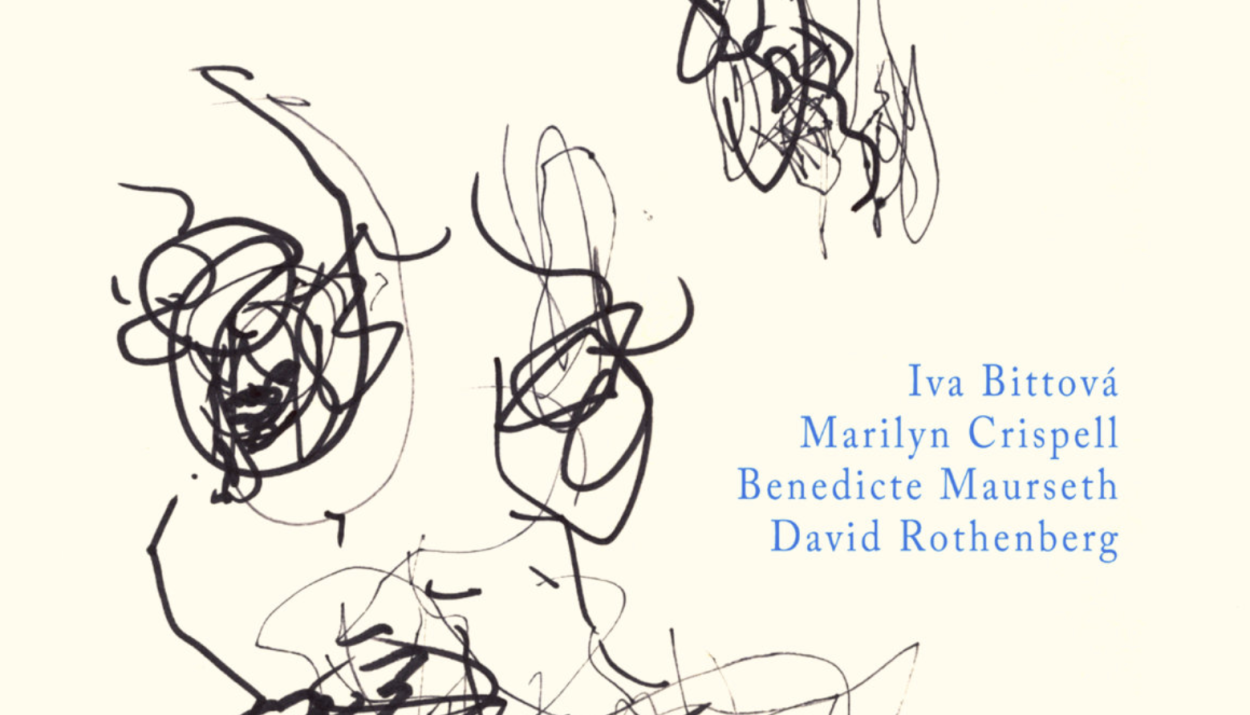

“Four Fold” introduces a remarkable quartet led by clarinetist-composer David Rothenberg, joined by NEA Jazz Master Marilyn Crispell, visionary Czech artist Iva Bittová, and Norwegian Hardanger-fiddle master Benedicte Maurseth. It’s a meeting of folk traditions, free improvisation, and the untamed grammar of birdsong—an ensemble that feels both ancient and boldly new.
Recorded in a single day at Nevessa Studios, the album’s sound is warm, intimate, and sharply detailed. Crispell’s piano and percussion shimmer with restraint; Bittová’s voice and violin feel elemental; Maurseth’s Hardanger fiddle brings spectral resonance; and Rothenberg’s reeds—along with field-recorded moths and magpies—thread the natural world directly into the music. The production preserves spontaneity while allowing each texture to speak clearly.
The album opens like dawn; “Folding” opens a horizon. The piano lies in soft, inquisitive shapes, while the clarinet hovers with attentive stillness. The fiddle threads the air in luminous drones, and the voice, half-breath, half-chant, guides the ensemble into motion—the theme: awakening, bending, entering the frame.
In “Ashlight,” the quartet captures something flickering and elusive. Crispell’s percussive touches turn the piano into a shadow-lantern, while Bittová’s violin scrawls delicate embers across the texture. Rothenberg’s tonal inflections evoke a bird testing its wings at the edge of darkness—a meditation on glow, impermanence, and the warmth inside cold places.
Drawing directly from the geological metaphor, “Syncline” dips and curves. Maurseth’s Hardanger fiddle takes center stage with serpentine bowings that create layered resonances. The ensemble responds like sediment settling—a slow-moving, organic choreography. A theme of pressure, history, and the inward folding of sound.
“Know No No” is with no vocals to lean on; the title becomes a conceptual rhythm. The group seems to treat it as a prompt: loosen up, ask questions, erase boundaries. Crispell’s percussive instincts shine here—her touches of hand percussion give the piece a heartbeat.
In “Ruffle,” bird-energy comes to the fore. Rothenberg’s clarinet work flickers and chatters with quick articulation while Maurseth and Bittová flutter around him in delicate, unpredictable patterns. The whole track feels like wings beating close to the ear.
“Anticline,” the geological twin to “Syncline,” but this time the fold arches upward. The music corresponds: spacious, rising, open. Crispell’s piano ascends in intervals that recall Messiaen’s harmonic language without quoting it. Rothenberg’s playing here is restrained and thoughtful, letting the shape of the track speak for itself.
The seventh song, “Magpie, Moth,” is Rothenberg’s signature territory: the meeting of human improvisers and non-human voices. Samples of the Death’s Head Hawk Moth and the Australian Magpie enter, not as gimmicks, but as ensemble members. It’s the most overtly interspecies moment on the album and one of its most striking.
Moving on, “Crinkle” is a textural miniature. Crispell and Maurseth explore small motions—creaks, snaps, crisp edges—while Rothenberg’s soft clarinet breath adds warmth. The piece feels tactile, like the sound equivalent of crumpling handmade paper.
“Soft Fall” is one of the album’s most atmospheric pieces. The group leans into quietude and gravity, letting notes drop rather than drive forward. The violin feels almost like a lullaby to the air around it. Rothenberg often speaks of slowing down to hear the world; this track embodies that philosophy.
A beautifully ambiguous title for a track that feels suspended, neither forward nor backward. Crispell’s playing in “Opposite of Time” is transcendently patient. The chords appear like drifting clouds. This song is a meditation more than a performance.
The album’s closing piece, “Unfolding,” mirrors the opener but in reverse: rather than folding inward, the music blooms outward. It’s a gentle but confident emergence, the quartet opening into daylight.
Recorded in a single, concentrated session at Nevessa Studios, the album retains the immediacy of four artists fully present with one another. Chris Andersen’s engineering captures not just notes but the air between them—true to the ECM-like clarity that has shaped so many of their individual careers. The instrumentation is ancient and experimental. The production never crowds you but frames each sound so its character can stand fully revealed.
“Four Fold” is a great achievement. It’s an album that honors folklore, jazz improvisation, natural sound, and avant-garde exploration without forcing them into a hierarchy. It is patient, imaginative, and deeply humane. Rothenberg and company invite us not merely to hear these birdsong transcriptions reborn but to inhabit them—to fold and unfold their meanings alongside the musicians.
Listen to the “Four Fold” album on Bandcamp
Follow David Rothenberg here for more information