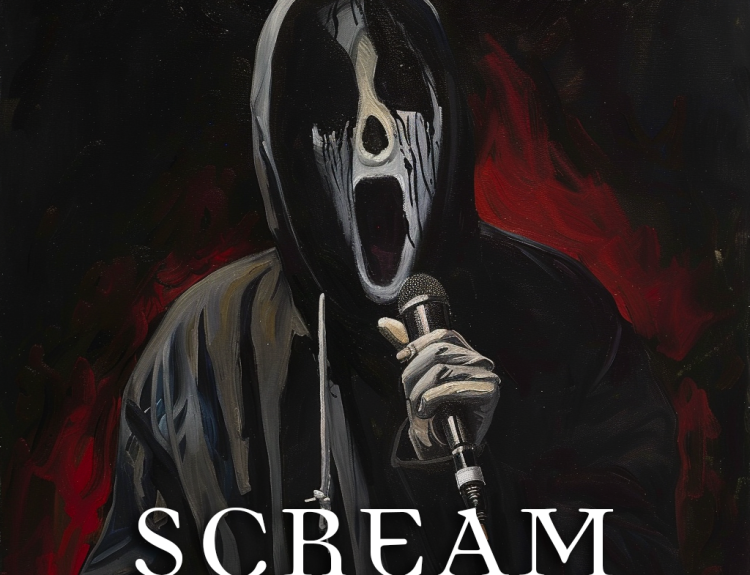
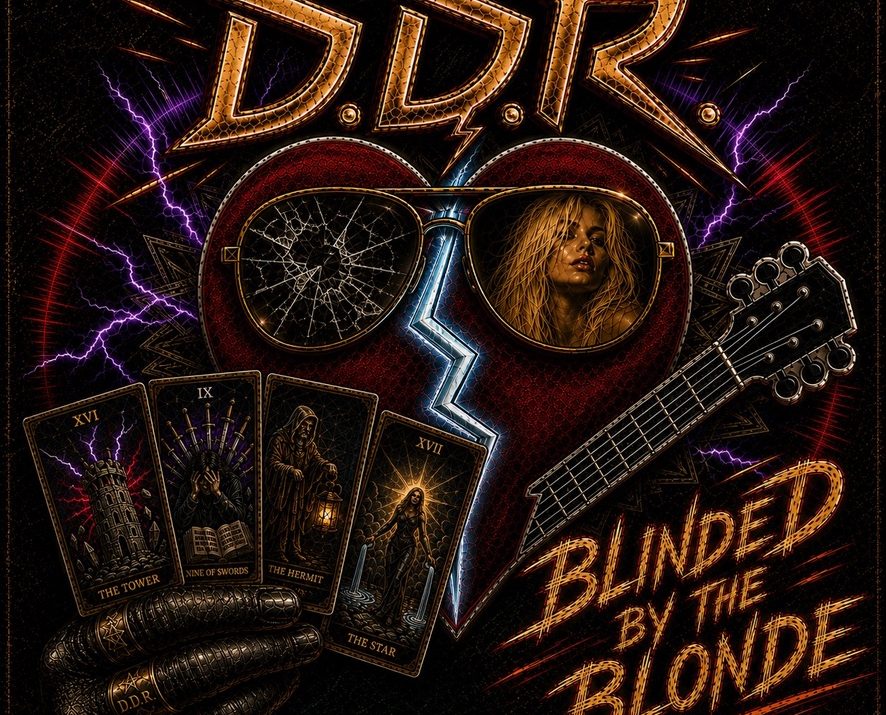

Stephen Paul, a novelist who has turned his heartbreak into a rock record, has adopted a suitable alias: D.D.R. – Divorced Dad Rock. Based in Indiana and firmly sticking to the grand tradition of arena songwriting, the project features large guitars, even bigger choruses, and narratives that never conceal themselves behind refined language. The outcome is not simply a matter of nostalgia. “Blinded By the Blonde” makes use of the powerful elements of classic rock to tell a highly modern and very human story concerning love breaking down and one man learning how to live on after that.
The reason why the EP becomes meaningful is because of Paul’s concept of “universal specificity”. Although the details are personal, the emotions can be identified by anyone who has loved, lost, blamed themselves, or questioned whether they still dare to start again. This is a well-deserved opening: D.D.R. comes with scars, hooks, and some genuine things to say.
The story starts with heartbreak, not with anger. “Never Forever” captures the painful moment at which a long-term relationship ceases to seem permanent and begins to look as if it had always been slipping away. The repeated awareness that “I thought it was forever” versus “It was never forever” forms the song’s emotional core. Paul’s way of singing matches the nature of the song since he doesn’t exaggerate the sadness; his performance sounds conversational and mature, which allows lines such as “I was just living on borrowed time” and “It’s not enough to be in love” to come across naturally. The melody bears the emotional impact, while the guitar-based production gives the song the scope of classic rock without overpowering the narrative.
The temperature goes up right away. “Sleepin With The Enemy” presents betrayal in the form of a cinematic rock narrative, full of snakes, poison, temptation, and self-blame. The lines “She sank her teeth in me” and “that poison bite caught me by surprise” bring the deception to life, while the EP serves as the key point showing how attraction had been used to conceal the danger. Here it is that the influence of D.D.R.’s arena-rock style is clearly evident: Paul’s vocals are sharper, the performance has a greater scale, and the chorus is designed to stay in the listener’s mind. The song progresses with confidence, combining a sense of wounded disbelief with enough swagger to prevent it from being just a revenge song. The statement that “this tragedy all falls on me” adds an important element of accountability.
Coming after two intense chapters, “Just 10 Minutes In” offers a pleasant amount of humour. It shows how quickly a usual argument between a couple can escalate into open conflict: after saying, “I’m not giving in, and she’s not giving in.” In this section, Paul’s manner of speaking sounds loose and lively, as if he is narrating a story to friends. The rhythm of the writing allows the performance to flow smoothly, and the production provides space for the conversational details to be expressed. Importantly, the song understands that conflict doesn’t have to result in disaster; anger turns into laughter and laughter in turn becomes affection. It is this final twist that gives the song a sense of honesty instead of cynicism.
The song “Anything Less Than More” becomes tender again. This is the kind of sound made by someone who is inside a relationship which they feel is too important to be temporary. The repeated references to “one kiss”, “one touch”, and “one night” give the song an intimate atmosphere, and the line “I wouldn’t trade it for anything less than more” makes longing the main idea. Paul’s vocals are softer and more open, showing another aspect of his singing style. Rather than taking centre stage, the guitars provide support so that the melody and the emotional inflections can carry the song.
The EP’s emotional core is “Don’t Tell Me How to Grieve”, which goes against the notion that heartbreak can be cured by following a set of instructions. The lines “My pain isn’t yours to alleviate” and “You’re the one who decided to leave” are not just accusations; they serve as boundaries. Paul’s performance is most effective when it appears controlled. The image of “memories as loud as thunder” is powerful, and the question “If I had known that the last time I saw you would be the last time I saw you” is what gives the song its greatest sorrow. The musical arrangement supports this sense of intimacy by keeping the lyrics at the forefront before the emotion surrounds them.
The betrayal tale is given a fresh perspective in “Sleeping With the Enemy (Alternate Mix)” without in any way losing its main impact. The line, “She sank her teeth in me before I even knew the stakes,” increases the feeling of danger, and the EP is still impossible to forget. The production has the same character as the original song: dark, well-polished, with the guitar as a leading element and centred on a strong vocal hook. Since we already know how the story turns out, Paul’s performance carries more tension; the line “I let her linger far too long” now sounds less like a surprise and more like a confession.
The final song concludes the entire journey. Having gone through betrayal, grief, regret, and emotional self-protection, “Make Me Feel Again” poses the main question of the EP: what occurs when you are finally ready to risk feeling again? Paul acknowledges that he is “shackled to the past” and asks, “Have I lost the opportunity to meet someone who cares?” Yet the song does not remain in a state of defeat. The key turning point is “I wanna feel that hurt again” since he realizes that pain is a part of being alive. Even the statement “Rejection is like a safety cloak for me” turns out to be an acknowledgment that protection can, in the end, become another form of imprisonment.
This is the appropriate conclusion in terms of tone and emotion. Although the performance has the dynamism of a climax from an arena rock song, the message is personal, not one of victory. The guitars and the melody convey a feeling of relief, while the vocals express the vulnerability that the entire EP has been leading up to. The fact that Blinded By The Blonde works is due to the production knowing what was required: large guitars, clear melodies, strong hooks, and sufficient space for the lyrics to be important. D.D.R. proudly displays its classic-rock influences, yet the songwriting ensures that the material remains based on real life rather than on imitation.
It is a story of heartbreak told with the insight of a novelist and the knack of a rock songwriter when it comes to writing a catchy chorus; it is raw rather than sour, amusing without downplaying the pain, and full of hope without pretending that the harm had not taken place. D.D.R. doesn’t just end Chapter One; he leaves the door ajar for the next chapter and provides us with a very good reason to continue reading.
Listen to the “Blinded by the Blonde” EP on Spotify
Follow D.D.R. here for more information.