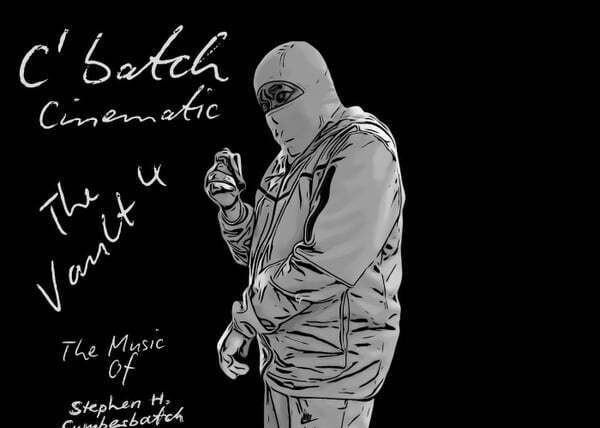

While some artists produce records and others produce songs, C’batch is the one who creates whole worlds. Once again, let’s welcome Stephen H. Cumberbatch, known as C’batch, the experienced composer, producer, guitarist, keyboardist, synthesizer player, and sampler programmer whose musical career has spanned many decades and genres, back to our blog. His work has spanned dance, R&B, electronic music, songwriting, and independent production, and thanks to his long association with Stevette Music, he has produced music without conforming to current fashions or industry expectations.
By releasing “The Vault 4 – Cinematic” on July 10, 2026, C’batch achieves something quite interesting in that he takes us to a destination without specifying exactly where that is. The twenty pieces and almost 58 minutes together form an imaginary film, the emotional content of which is provided by orchestral textures, piano, synthesizers, atmospheric electronics, and carefully placed percussion. Stay with me for more.
The album begins with ‘The Beat of the Night (Alternate Version)’ showing off some movement, as atmospheric synths and electronic percussion produce a nocturnal rhythm that at once evokes city lights, motion, and possibility. The opening is confident since C’batch doesn’t take the time to explain the mood; he just sets it.
In “Clubadub (Cinder Circuit Game Board) 3,” the cinematic world becomes more playful and futuristic; the title implies machinery, games, and electronic movement, and the music matches that imagination with a sense of rhythmic calculation, so that it is as if one is seeing the various pieces move across a luminous board.
“Breaking My Heart (Cinematic & Orchestral 1)” is the emotional impact of heartbreak on a large scale. The use of an orchestra provides a broader emotional context to personal sadness, whilst the melody ensures that the piece remains human. It is one of the album’s first emotional highlights for me.
The short, taut, and psychological piece, “Trapped (Mental Telepathy Is) (2)”, has the effect of an internal dialogue; its brevity is to its advantage since, instead of settling all the issues, it leaves you immersed in the tension.
The atmosphere becomes more pleasant with the track “Ascension (To Our Love)****,” since the warm harmonic progression gives the album a feeling of hope, affection, and emotional relief. Following the darker tension of the tracks that came before, this is similar to seeing light coming through a window.
The cinematic version 2 of “Next Time (I Won’t Be Falling)” is one of the most effective examples of musical storytelling in the project. The piece, which was originally linked with emotional conflict, is here given a more dramatic and orchestral treatment, and fragility turns into determination, thus demonstrating how well C’batch can take an existing idea and yet avoid making it seem simply recycled.
“Spring (Alternate Version)” provides a pleasant change in temperature. The delicate melodic passages suggest renewal, new beginnings, and the gentle optimism associated with a season changing. It gives the album space to breathe.
The song “Have You? (Alternate Version)” is more reflective and questioning, almost as if the idea is left unanswered. C’batch realises that cinematic music doesn’t always have to have a dramatic climax; in some cases it is the unanswered question that constitutes the scene.
Rhythm is once again in the spotlight. Although “Cop the Night 2*** (2)” has a quiet sense of urban activity, it still retains the open, spacious character of the album, and it serves as a reminder that C’batch’s instinct for dance music has not vanished. It has just learned to serve the story.
“Badabing (Cinematic 2) (2)” is once again a lively dramatic shift, with the use of percussion and orchestral intensity giving it the sensation of action, as if a scene were unfolding rapidly on screen; the piece is concise yet effective.
With “The Dance Song (Alternate Version)” we already have the answer: movement is the main feature. C’batch shows that cinematic composition and electronic groove need not be in competition; his experience in dance proves to be an asset, giving the arrangement a natural flow.
It is perhaps the most intimate moment on the album. In “That Sparkle in Your Eyes,” the piano acts as the emotional focal point, surrounded by warm cinematic textures. The piece comes across as tender, not sentimental, and it is exactly this control that makes it memorable.
In “The Chase in the Maple Thunderlight 3,” the imaginary film suddenly speeds up and, thanks to its tense orchestration and dramatic pacing, becomes an action sequence, which shows off C’batch’s ability to control tension and its release.
In “The Gift (Alternate Version),” the atmosphere once more becomes calm; a subtle elegance is present, as though the story has reached a point of gratitude or of quiet realization. This is yet another instance of C’batch knowing when not to exaggerate an emotion.
Intentionally ambiguous, “In the Mood?-2” does not specify the emotional conclusion. The music carries on with the album’s reflective character, combining atmosphere and melody so that we can assign the meaning as listeners.
The track “Next Time (I Won’t Be Falling) 1a” comes back to the ‘Next Time’ theme and thus provides a sense of continuity to the album’s narrative. Instead of just reiterating the same idea, C’batch makes the repeated composition seem like another chapter in the same emotional story.
One of the main themes of the project is reinforced by the second “Breaking My Heart (Cinematic Version 2)” interpretation: the same emotion can have different expressions. Instead of following a traditional song structure, the cinematic version goes further into the realm of score.
The shift in tone that occurs late in the album, “Trina-Tina 2***”, helps to keep the overall journey going and adds to the album’s wider emotional collage. It sounds more like one scene among others than a standalone track.
The song “All For You” sharpens the emotional expression by emphasizing devotion, commitment, and total self-giving. Since it comes so late in the sequence, it has the effect of serving as a sort of personal statement right before the end.
What a way to end an album. And in keeping with this, the finale has a dreamlike and imaginative quality since “Underwater Chorus Chrome Carousel Groove 1” combines C’batch’s interest in electronic sound design, rhythm, and melody, taking us somewhere between an underwater dream and a spinning cinematic carousel. Although the conclusion is unusual, that is precisely why it succeeds.
“The Vault 4 – Cinematic” is different from just a set of instrumental tracks, thanks to its element of control. C’batch is skilled at layering without making the arrangement too busy. The piano and keyboards form the human core; the synthesizers and ambient electronics broaden the atmosphere; the orchestral parts give it scale; and the percussion governs the movement and the sense of suspense. C’batch’s performance is just as impressive in that it is not concerned with displaying technical ability. Rather, it serves the image which exists only in our minds. The decades of experience that he has as a composer, producer, guitarist, and electronic musician are clearly noticeable in the way acoustic-style emotion and programmed textures go hand in hand.
C’batch is here, going beyond the boundaries of genre and entering the world of musical storytelling. Although he respects his background in electronic and dance music, he also adopts orchestral drama, ambient atmospheres, and melodic intimacy. The music is certainly suitable for filmmakers, music supervisors, and creators, but it is also music for you willing to close your eyes and let your imagination take charge. Instead of giving us a film, he gives us the score and leaves us to create the film ourselves. And after all these years of making music, that might well be one of his most impressive phases yet.
Listen to “The Vault 4 – Cinematic” on Spotify
Follow C’batch here for more information