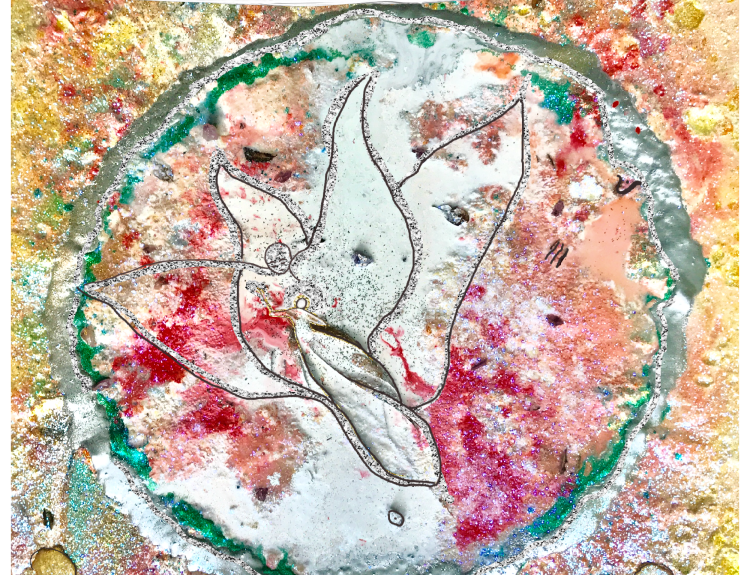


Some artists create songs, while others craft albums. Brooke Tamsin Clevenger seems to be building something broader: a universe filled with ideas, sounds, memories, questions, and emotions. Based in Belfast, she leads Cognitive Constellation Corps as a composer, lyricist, producer, and conceptual director. She began connecting with electronic music in the mid-1990s, and her experience with synthesizers and computer-based systems gives the project a strong technological identity.
Out on 10 April 2025, “Thank You for Your Feedback (I)” transforms the language of computers, customer service, surveys, and automated messages into something warm, thoughtful, and human. Instead of criticizing technology, the album explores how our feelings change when systems constantly ask for our responses. It reveals its answer through melody, repetition, electronic textures, gentle vocals, and quiet humor. Let’s do a track-by-track journey of the album.
The album’s first track, “Opening Loop (i),” sets the tone through repetition and atmosphere. It feels like an invitation into a cycle of communication, memory, and response, with electronic textures creating movement without overwhelming you. The track introduces a machine-like environment that still feels very human. It never ceases to amaze me how beautiful this opening track is.
The second track, “Signal Received (i),” expands on the theme of communication. A technical phrase becomes emotional, suggesting that a signal can be a message, memory, feeling, or proof of being heard. The vocals are soft and warm, and electronic production balances technology with intimacy. This song has a nice and catchy groove that makes me more invested in listening.
The title track, “Thank You for Your Feedback (i),” embodies the album’s central idea. By taking a familiar automated phrase and infusing it with emotional weight, Clevenger transforms institutional language into something personal. The smooth vocals and relaxed electronic production make the phrase feel less like a robotic response and more like a genuine expression of gratitude and connection. It’s refreshing how the vocals clearly sit in the mix.
“Echo Chamber (i)” delves into repetition, memory, isolation, and the ongoing nature of communication. Repeated sounds and layered textures create a digital space where ideas bounce back and return altered. An echo also confirms that something has been said, leaving behind a trace of the original voice.
The fifth song, “The Curve of Clarity (i)” depicts the slow journey from uncertainty to understanding. Its reflective vocals and electronic textures mirror the processes of listening, interpreting, reconsidering, and responding. Here, technology is not merely decoration; it is part of the storytelling. If you’re looking for something exciting to listen to as you scroll through the album, this is one of those gems.
“Threadbare, Threadshare (i)” is one of the album’s most poetic titles. It’s about worn connections, shared experiences, and fragile relationships. Electronic layers become musical threads, woven together into a larger emotional fabric. The song reflects the album’s belief that technology can divide people, but it can also foster new forms of connection. This song is worth listening to, thanks to its beautiful vocals and lyrics.
“The Response Loop (You’re Still Talking) (i)” articulates the album’s main theme most directly. The phrase “You’re Still Talking” turns a technical loop into something intimate, suggesting persistence, memory, hope, or a relationship that continues after silence. Repetition feels vibrant here rather than mechanical. The beats and vocals complement each other so nicely. I couldn’t get enough of the vocals; they remain uniform and present all through the song.
The eighth track, “Harmonic Distortion (i)” examines what occurs when communication is altered. Distortion does not necessarily ruin sound; it can transform it into something new. Processed textures and electronic layers reinforce the idea that imperfect communication can still transport meaning and lead to unexpected beauty.
“Always (Sevahem) (i)” concludes the album with a sense of permanence. After so many signals, loops, echoes, and responses, “Always” feels almost like a promise. Instead of answering every question, the final track leaves you with the sense that communication continues beyond the last note.
The album’s vocal style is intimate and understated rather than flashy. Soft, calm delivery blends seamlessly with the electronic arrangements, allowing the music to remain emotionally engaging. Subtle shifts in performance and vocal processing add warmth, depth, and meaning to the album’s thoughtful themes.
The album’s production stands out as one of its strongest aspects. Synthesized sounds, computer-based production, layered textures, vocal processing, programmed elements, and carefully shaped arrangements create a modern sound without feeling sterile. The careful use of space also lets the melodies and emotional details breathe.
The AI-assisted tools also play an important role in the album’s story. Voices and textures contributed by AI were selected, reshaped, and refined through traditional production techniques. Thus, the technology serves as part of the artist’s toolkit rather than replacing the artist. This makes the album less about “AI music” and more about what it means to live creatively in a technological age.
In the end, “Thank You for Your Feedback (I)” is an album focused on communication that acknowledges silence. It is an electronic record that never loses touch with the human within the machine. Cognitive Constellation Corps has developed a unique artistic voice where technology, emotion, memory, and connection converge. Like individual stars gradually forming a bigger picture, the songs reveal their meaning through repetition and association. The outcome is thoughtful, intimate, and quietly powerful music that encourages us to listen not just to the systems around us, but to the human voices that still speak within them.
Listen to the “Thank You for Your Feedback (I)” album on Spotify
Follow Cognitive Constellation Corps here for more information