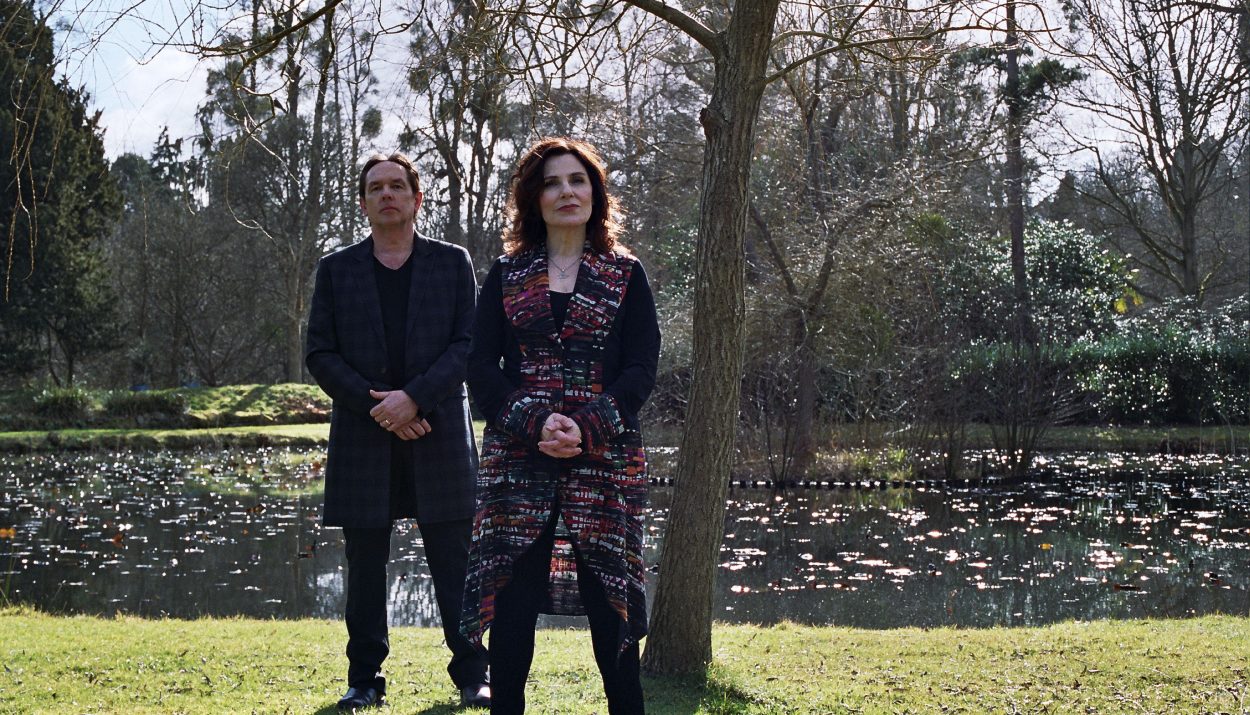

After their last appearance with Pertinax, Suris returned not as a nostalgia act but as quiet architects of atmosphere. Lindsey and David Mackie operate in a space where elegance and unease coexist: polished arrangements, rich vocals, and stories that subtly unsettle. Rare Brew feels less like a compilation and more like a reclaimed identity—songs written across decades, now unified through careful remastering and renewed intent.
Lindsey’s voice is the album’s constant compass: textured, intimate, and emotionally restrained, yet always expressive. There’s a sense of control in the delivery—nothing is over-sung—allowing the narratives to breathe. Dave’s production is equally assured, blending guitars, keys, and understated electronics into a sound that nods to the ’80s and ’90s while remaining unmistakably personal.
The album opens with a sense of artificial comfort—smooth, controlled, and faintly unsettling. “Astrosurf” feels like a commentary on manufactured realities and emotional insulation. Lindsey’s vocals glide effortlessly, almost deceptively calm, while the arrangement subtly tightens around her. It’s a confident opener that establishes the album’s central tension: beauty versus truth.
Urban, observant, and quietly cinematic, “This Is The City” feels like walking alone through city streets at night. The performance is restrained but evocative, with Dave’s guitar textures adding grit beneath the polished surface. Lindsey delivers the lyrics with a storyteller’s detachment, as if reporting on lives brushing past each other, never quite connecting.
As one of the emotional highlights of the album, “Great Wide Open” is stripped back and intimate, carrying a gentle Space Oddity–era vulnerability. The sparse instrumentation gives Lindsey’s voice room to breathe, and the song feels expansive despite its minimalism. There’s a sense of longing here—not for escape, but for meaning. Listening to it feels like staring up at a night sky that offers no answers, only perspective.
Originally recorded in 1992 on a Fostex 8-track reel-to-reel, “Big Ship” carries its history proudly. The retained elements of the original recording give it a raw authenticity that modern polish couldn’t replicate. The song feels like a slow-moving metaphor—perhaps for fate, perhaps for inevitability—anchored by steady instrumentation and a vocal performance that feels both patient and resigned.
Atmospheric and quietly haunting, “Scaur Bank” leans into mood and texture. The instrumentation ebbs and flows like tidewater, while Lindsey’s voice feels almost ghostlike at times. This is one of those tracks that rewards close listening; its emotional impact grows subtly, rather than announcing itself outright.
Dark, assertive, and unapologetic. “Hellion” has teeth. There’s a tension between the smoothness of the production and the underlying aggression of the song’s spirit. Lindsey’s delivery is controlled but pointed, while Dave’s guitar work adds edge without overwhelming the track. It’s easy to hear why this resonated with industry listeners.
The seventh song, “Warrior Queen,” is unquestionably one of the album’s daring moments. Beginning with an acoustic upright piano, the track slowly builds into a powerful, rule-breaking finale of guitar, synth pulses, and layered vocals. This track feels theatrical without being indulgent, a sonic battle that mirrors its title. Lindsey’s vocal performance here is commanding and embodies vulnerability and defiance.
Cold, sparse, and emotionally distant in the best possible way. “Absolute Zero” feels like emotional stasis—after loss, after realization. The arrangement is restrained, allowing silence and space to become part of the composition. Lindsey’s delivery is almost detached, making the moments of warmth feel all the more impactful.
Fluid and introspective, “Riverman” carries a sense of quiet movement. The instrumentation flows gently beneath Lindsey’s voice, creating a reflective atmosphere that feels timeless. This track is deeply human. It’s an acknowledgment of change, passage, and inevitability.
Melancholic and poignant, “Last Fish In The Sea” feels like a meditation on isolation and survival. The performance is understated but emotionally precise. Lindsey sings with a softness that suggests acceptance rather than despair, while the arrangement supports the narrative without drawing attention to itself.
One of the tracks with roots in the early 90s recordings, “Vertigo” retains a raw, slightly unsteady energy that suits its theme perfectly. The song feels disorienting in a deliberate way, with shifting textures and a vocal performance that mirrors emotional imbalance without ever losing control.
The album closes with reflection rather than resolution. “All Over Again” feels cyclical—about patterns, mistakes, and the strange comfort of familiarity. Lindsey’s vocal delivery is warm and weary, and the instrumentation gently fades rather than concludes, leaving the listener suspended in thought.
Listening to “Rare Brew” in its entirety felt like spending time with a trusted storyteller who knows when to speak and when to stay silent. There’s no filler here, no attempt to modernize for the sake of relevance. Instead, Suris offer something rarer: music that trusts the listener. This album doesn’t demand attention—it earns it. If you are discovering Suris for the first time, Rare Brew is an ideal entry point, and for longtime followers, it’s a reaffirmation of why these songs mattered then and why they still matter now.
Listen to the “Rare Brew” album on Spotify
Follow Suris here for more information