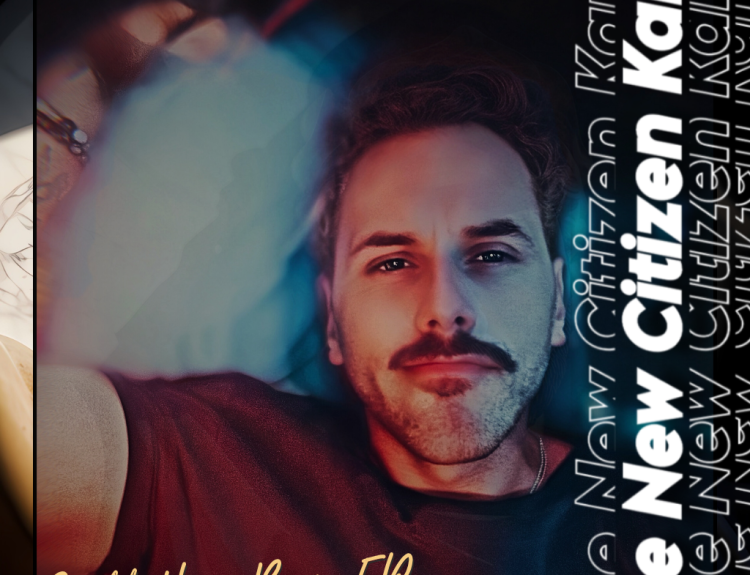


Ashley Ray Simon does not arrive on Terra Santa like an artist asking for attention. He arrives like someone reclaiming a space that has always belonged to him. That is the feeling this EP carries from the first breath to the last: not a debut, not a correction, but a revelation. For listeners who first met him here through “Vaya Con Dios” earlier this year, this re-release feels like the moment the door swings fully open. What was once a hidden gem now stands in the light with a new kind of confidence, and it earns that spotlight immediately.
Simon is a British artist based in Portugal, but his sound feels borderless in the best way. He writes and performs like someone guided less by genre than by instinct, building songs from raw vocal presence, lived-in guitar tones, and a stubborn devotion to feel over precision. On Terra Santa, that instinct blooms into a rich and layered statement. The EP moves through retro soul, psychedelic rock, folk, and alternative pop with ease, but it never sounds like a genre exercise. It sounds like memory. It sounds like an ache. It sounds like the kind of music that has been carried around in the body for a long time before it finally gets sung out loud.
What makes the record so affecting is its balance of control and looseness. The production has shape, but it never feels over-polished. The instrumentation has texture, but it never crowds the songs. Guitars arrive slightly weathered, drums feel human and room-bound, and the whole EP seems to breathe with a warm, analog pulse. Even when the arrangements stretch outward, they keep a handmade intimacy. You can hear intention in every layer, but you can also hear accidents embraced, edges preserved, and emotion allowed to lead.
Simon’s vocals are the center of it all. He sings with a voice that feels unguarded, weathered in the right places, and alive with friction. He does not smooth emotion into something neat. He lets the cracks stay visible. That is where the power is. His delivery can be tender, sly, haunted, or defiant, often within the same song. He has the kind of phrasing that makes a line feel like it was discovered rather than performed. Whether he is leaning into a hushed confession or opening up into a rougher, fuller register, there is always a sense that he means every syllable. That commitment gives the EP its pulse.
“She” opens the EP with a kind of magnetic simplicity. It feels like an introduction shaped from longing and recognition, the sort of song that watches someone from a distance and understands more than it says out loud. The theme hovers around desire, presence, and the mystery of another person who cannot quite be held. Simon’s vocal here feels intimate and slightly searching, with the instrumentation supporting that emotional uncertainty through soft movement and atmosphere. The track establishes one of the EP’s key strengths: even when the writing is direct, it leaves room for implication.
“All Night” stretches the EP into something looser and more nocturnal. The title suggests persistence, repetition, and the strange emotional drift of being awake when the world is quiet. The theme is desire, restlessness, and the refusal to let a moment end. This is where Simon’s instinct for groove and feel over grid becomes especially important. A track like this benefits from rhythm that moves like a body rather than a machine, and that human sway gives the song its late-night pull. It feels lived-in, not manufactured.
The third song, “Running,” brings motion into the foreground, and with it comes tension. The song reads as a search for escape, clarity, or perhaps emotional survival. Running can mean flight, but it can also mean determination, and Simon seems well-suited to singing from that edge between vulnerability and resolve. The instrumentation mirrors that forward pressure, with guitars and drums creating momentum without losing the EP’s organic looseness. It is one of those tracks that seems to carry more than one emotional meaning at once, which gives it depth.
“Fire” shifts the temperature. If “She” is the spark, “Fire” feels like the burn. The song carries the energy of urgency, release, and emotional combustion. There is a cinematic quality in the title alone, and the music is built to match it, with a push from guitar and rhythm that gives the track a more physical edge. Simon sounds especially alive in moments like this, where the performance can open up, and the vocal grain becomes part of the drama. It is the kind of song that does not simply describe intensity; it generates it.
“Dance With Me” feels like the EP’s most openly inviting moment, though even here Simon’s world is not purely celebratory. The title suggests closeness, surrender, and connection, but in his hands, that invitation may also hold tension, hesitation, or yearning. This is where his gift for blending sensuality with melancholy becomes especially compelling. The groove matters just as much as the lyric, and the arrangement leans into that push and pull between movement and feeling. It is a song that lands with the body and the heart.
The “All Night (Radio Edit)” and “Fire (Radio Edit)” versions close the release with a different kind of utility. They do not feel like afterthoughts so much as alternate frames, sharpening the songs for a more immediate listen while preserving the emotional core. Their presence reinforces how strong the original material is: these are songs sturdy enough to survive condensation without losing their character. In that sense, the radio edits also underline the EP’s confidence. The material does not need embellishment to matter.
As a complete work, “Terra Santa” feels restorative and alive. It carries the warmth of retro soul, the haze of psychedelic rock, the honesty of folk, and the hookiness of alternative pop, but what gives it identity is Simon’s sense of touch. He seems to understand that the most affecting records are often the ones that leave a little room for breath, a little room for imperfection, and a little room for the listener to enter. That approach gives the EP emotional credibility. Nothing here feels lacquered to death. Everything feels earned.
Listening all the way through, I felt less like I was consuming a release and more like I was being ushered into an artist’s private weather system. There is heartbreak here, but also movement. There is nostalgia, but not stagnation. There is polish, but not at the expense of soul. By the end, Terra Santa does what the best re-releases do: it makes the past sound newly necessary. Ashley Ray Simon deserves a welcome that feels bigger than a passing nod, because this EP does more than reintroduce him. It confirms him.
He sounds like an artist with a vision, a pulse, and the courage to trust both. And with “Terra Santa,” that trust pays off beautifully.
Listen to the “Terra Santa” EP on Spotify
Follow Ashley Ray Simon here for more information