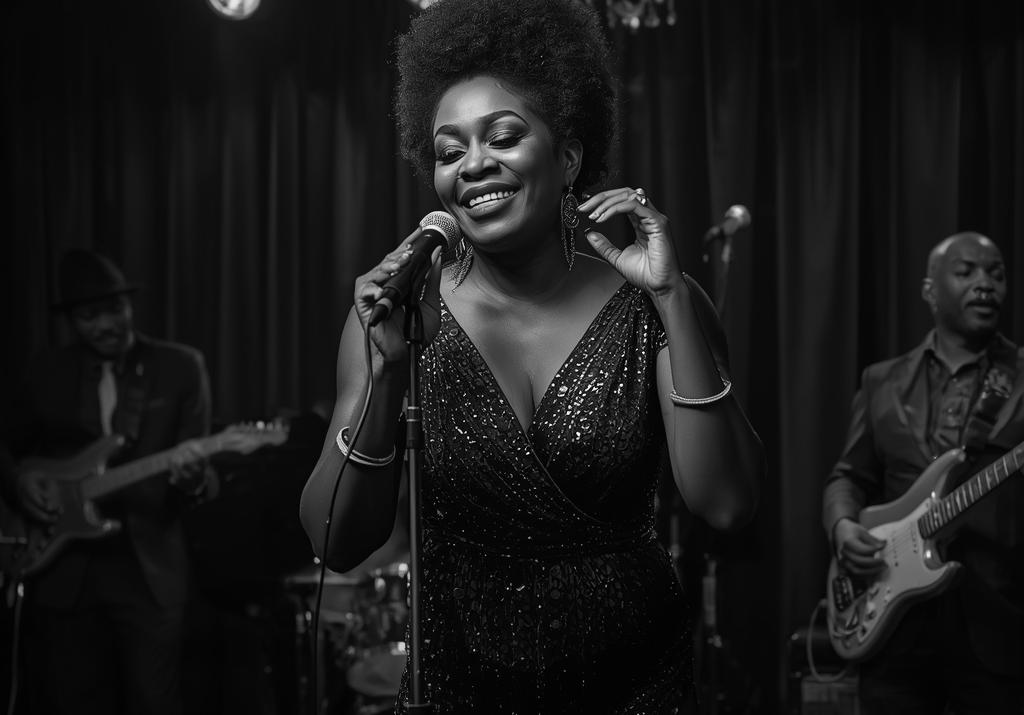

Ella Fitzpatrick enters the modern jazz-swing scene like a bright signal in the dark, impossible to ignore, warm, and almost cinematic. Born in Detroit and influenced by gospel traditions, she brings that emotional depth into everything she does. However, she doesn’t let it limit her. Now living between Sweden and Denmark, she embraces the clarity and control of Scandinavian music while holding onto the American soulfulness that shaped her voice. The result is an artist who feels grounded and restless, classic and modern at the same time.
On “Big Band Reflections,” created with Kent B. Nyberg, Fitzpatrick doesn’t just look back at the big-band era—she reframes it. Brass arrangements, modern pop elements, jazz phrasing, and personal storytelling work together seamlessly. At first, I listened not as a critic but as someone drawn into a series of emotional spaces. Every track revealed a new facet of honesty. Let’s dive into it.
The album starts with a burst of emotion. “In The Mood Today” captures the exact moment when hesitation fades away. Lines like “Backspace on brave. Like it’s some kind of race” strikes a clever and painfully relatable chord. Fitzpatrick transforms self-doubt into something alive with rhythm. Then the chorus reveals a rush of clarity: “I’m in the mood today. To say the thing I never say.” Her voice here is playful but carries urgency, as if she’s smiling through a surge of adrenaline. The production is clear and never overpowers her phrasing. I felt a sense of emotional encouragement listening to it, as if the song was pushing me forward.
“Dancing in a Dream” takes the album in a more introspective direction. It explores emotional uncertainty, where connection feels real yet unsteady. “I’m in over my head… but I don’t wanna stop” captures that contradiction perfectly. Even more haunting is “we’re not breakin’ up ‘cause we were never in love,” a line that feels like a quiet collapse rather than a climax. Fitzpatrick’s voice here is breathy and controlled, almost like she’s speaking from within a memory she can’t fully escape. The production is delicate. I found this song emotionally disorienting, beneficially, like being still while everything else slowly turned.
“Maybe Fly To The Moon” reintroduces warmth. The song feels like a movement turning into romance. With lines like “If it’s you in the passenger seat” and “We don’t have to know where we’re going,” the song creates a sense of intimate connection, while “Forever to start now” opens it into something quietly expansive. Ella Fitzpatrick’s vocal delivery is close and playful, almost smiling through the words. The arrangement feels airy. It’s spacious enough to feel cinematic but never overdone. I felt like I was moving while listening, even though I was completely still.
The fourth track, “Feel Good,” acts as a powerful affirmation, but it doesn’t feel hollow—this is emotional simplicity used meaningfully. “When you tell me I’m pretty” and the repeating hook “You know I feel good” are delivered with gentle confidence, not overstatement. There’s a subtle emotional need in “Can’t get enough of it,” which Ella sings with enough repetition to make it linger. The production is modern and clean. I thought about how rare it is for a direct song to still feel emotionally rich.
With “Not Without You,” the album dives deeper into longing. “Drivin’ past the driveway” and “I don’t think I can live without you” paint a clear sense of absence—memories tied to place. Fitzpatrick’s voice gradually lifts from control to emotional intensity, making this one of her most powerful performances on the album. The instrumentation swells with piano and beautiful sounds, but never takes attention away from her voice. I experienced this track more profoundly in my chest than in my mind; it remains with you.
“What Do You Have To Lose” marks a turning point in mood, where vulnerability shifts to negotiation. The line, “What do you have to lose,” serves as a plea and a challenge, while “If you fall, then fall on me” comes with quiet urgency. Ella’s delivery blends fragility and strength, and the production reflects this balance with soft piano, gentle electronic pulses, and a slowly building atmosphere. This track feels like emotional reasoning unfolding in real time.
“Borrowed Time” stands out as one of the most grounded and authentic tracks on the album. Lines like “rent due,” “credit line,” and “living on borrowed time” turn financial struggles into emotional depth. Instead of dramatising it, Fitzpatrick approaches it with restraint, almost like a documentary. Her voice is intimate, slightly worn, and sincere. On the other hand, the sparse instrumentation allows the lyrics to breathe. I found this track quietly heartbreaking; not loud in its sadness but persistent.
The eighth track, “Whirlpool,” presents a cyclical emotional trap in sound. The lines “Living in a whirlpool” and “round and round the same old view” evoke a sense of exhaustion that never resolves. Even the production feels circular—rhythms that repeat rather than advance. Ella’s vocal performance is compelling here: controlled and conflicted, as if each line is being pulled back into the same emotional current. Listening to the song will make you feel slightly trapped in a way that feels purposeful and effective.
“Through My Soul” shifts toward emotional healing. Lines like “you know you can save me” and “forgive ourselves” give the track a redemptive core. Fitzpatrick embraces sincerity without losing nuance. The production warms, featuring soft lifts and gentle expansiveness. It feels like emotional breathing after a tight hold. I found this track quietly hopeful, as if the album were rediscovering how to heal.
Grief enters with clarity and tenderness in “In My Memory.” Lines like “You are so alive in my memory” keep the track anchored in a sense of presence instead of absence. Everyday objects transform into emotional echoes. Ella’s voice is restrained and deeply expressive, while the production remains sparse. This song lingered with me after it ended, like something unfinished yet understood.
Next, “Leaning In” explores emotional residue. “Every empty room sounds like you’re here” and “Still I move aside, like I’m saving you a chair” hit powerfully in their simplicity. Fitzpatrick’s delivery is fragile, almost whispered, and the production captures emotional emptiness with space and restraint. I felt suspended while listening—like a memory occupying a physical space.
“Face On The Moon” represents a celestial longing. “When I look at the stars. I see your face on the moon,” turns distance into something mythic. “If distance is endless. I’ll make it a room” is one of the album’s most poetic reframes of love. Ella’s voice is sweet and intimate, almost unguarded. The production is expansive and atmospheric, giving the song a sense of floating. It felt like looking outward and inward simultaneously.
“No Room” shifts the tone. It’s sharp, witty, and emotionally guarded. “I don’t have room in my apartment for your soul,” and “You say your name is Faith, but I think you are fakin’” bring scepticism and humour to the forefront. Her voice feels conversational, controlled, and slightly ironic. The production is straightforward, allowing the lyrics and personality to shine. I appreciated this moment of edge—it breaks the album’s emotional softness with intelligence.
“My Way Tonight” is a quiet song of empowerment. “Past the doubt. ‘Past the better not’ feels like overcoming internal resistance. “Mirror says you might be tired,” which keeps it grounded in reality. Her vocal grows from hesitation to freedom, and the production lifts subtly—pulsing beat, light shimmer, and forward motion. I felt the song as a personal victory rather than a public one.
Finally, “Dance With My Soul” serves as an emotional closing. Lines such as “dance with my soul” and “spin me out of control” depict intimacy as complete emotional exposure. “Every scar, every hope” is sung with a softness that feels well-earned by everything that came before. The arrangement is simple and warm, allowing her voice to carry the weight of closure. I felt a sense of emotional completion here, not perfect resolution but acceptance.
“Big Band Reflections” isn’t just a stylish experiment. It’s an emotional framework built across genres. The big-band influence provides depth, but Ella Fitzpatrick’s real power lies in intimacy. She doesn’t just convey emotion; she tracks it, breath by breath. Nyberg’s production keeps her voice at the centre, whether surrounded by bright brass or in near silence. The instrumentation consistently supports the storytelling: sometimes lush and cinematic, other times stripped back to near-whispers.
What resonated with me the most is how human the album feels. Even at its most orchestrated, it never loses its connection to vulnerability. I didn’t just hear songs—I journeyed through various emotional states, each carefully illuminated and each genuine. Ella Fitzpatrick doesn’t arrive as a newcomer on this album. She comes as someone already fluent in emotional truth.
Listen to the “Big Band Reflections” album on Spotify
Follow Ella Fitzpatrick here for more information