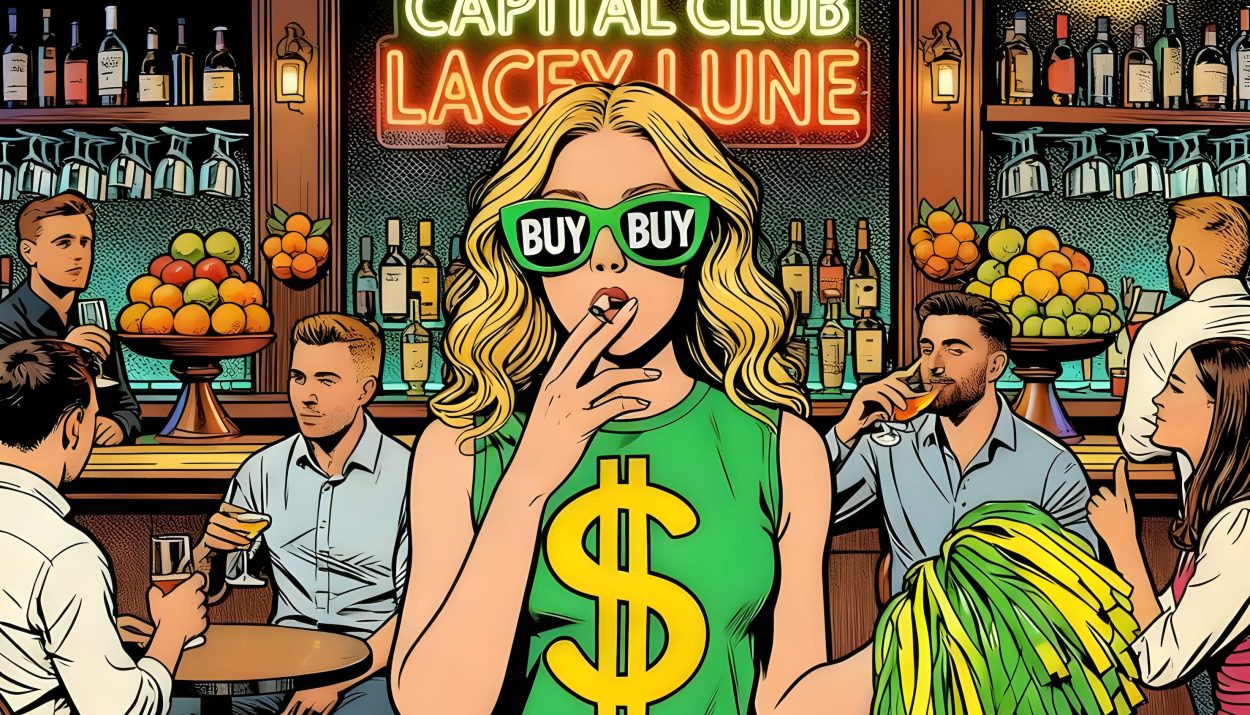

Make room for a new kind of pop provocateur. Lacey Lune comes in with a sharp tongue, a broken heart, and is completely indifferent to maintaining appearances. As the alter ego of Jessica Rae Lundstrom, a Mormon foster child from San Diego, Lune is an artist who works across genres, sees beauty in contradictions, and finds humour in the uncomfortable aspects of life. She has the ability to make glamour seem dangerous, make vulnerability appear theatrical, and have a catchy melody convey an idea that stays with you.
Through “The Capital Club,” she provides an exceptional look at modern identity, emotional survival, and the nature of being oneself. Over the course of 17 tracks, retro soul, glam-pop, noir electronics, bruised balladry, and spoken-word satire all contribute to a deliberately unsteady overall effect. It is pop music that carries a raised eyebrow and has a bruise under its makeup. Let’s now carry out a track-by-track review.
“Nothing Feels Normal Anymore (Pt. 1)” begins by creating a feeling of discomfort that is at the same time personal and cultural. It sets out Lune’s main tension, which is the difficulty of finding something genuine in a world in which all emotions appear to be prepared for public display. She combines a cool detachment with moments of emotional disturbance in her performance, and the production gives an air of refined disorientation.
“Remind Me, How Much Are We Talking About?” puts money and human relationships into the same awkward situation. The title implies a negotiation where sincerity takes a back seat to the amount of money involved. Because of the way Lune phrases the song, it has a sly and theatrical touch, so that the satire comes across not as a lecture but rather as a private joke which all people understand.
“The Winners of Capitalism (feat. Nada UV)” seems, on the face of it, to be a kind of celebration of victory organised by individuals who have learnt how to sell themselves before the market gets around to doing it for them. By including this track, the album adds another perspective to its criticism of ambition, the need to survive, and self-commodification. At the heart of Lune’s vision is this poisonous kind of triumph: it is possible for success to appear spectacular while at the same time quietly eating away at the person who achieves it.
“The Girlfriend Experience with Knife Skills” puts intimacy alongside danger, implying a world in which affection can be turned into a carefully carried out service. The title itself shows Lune’s usual combination of glamour and threat. Her love of theatre matches the concept exactly, as it transforms romance, role-playing and emotional labour into a disturbing picture of relationships carried out in a professional way.
The aim of “Be My Producer” is to explore the complex relationship between artistic freedom and the individuals who help to package it; at the heart of its provocative idea is a question concerning control, namely, who is entitled to shape an artist’s identity and what occurs when the person who creates the work also becomes the product? The concept combines Lune’s pop style with her satirical aspect and seems perfectly suited to this album.
“The Pay You on Friday” introduces financial promises into the emotional realm. The title implies delayed payment, unstable agreements, and the uncomfortable gap between what people promise and what they are able to deliver. Its position on the album supports the view that capitalism is not just an economic system in this context; it has become a language that seeps into personal relationships.
“Greenland Is Open for Business” takes the satire further by using the language of territorial ambition and business opportunity. The wildly confident title implies a world in which anything, even the most unusual places, can be viewed as an investment. It then becomes clear what Lune’s bigger project is: commercial logic has become so dominant that the absurd can still be treated as serious.
“Guess We’re Done Pretending” might mark a turning point at which the effort to appear normal starts to break down. The title suggests a sense of exhaustion, resignation, and possibly a small amount of relief as well. With Lune involved, the act of confiding becomes one with the confession itself, leading to the question of whether honesty can endure once it has become yet another performance.
“The Nurse with Wound List” is a particularly interesting standout. It is a touching and surprisingly catchy love letter to the idea of radical listening, showing how connection can be achieved by being willing to hear another person without at once attempting to fix them, categorise them, or turn their suffering into something that can be sold. The contrast between the song’s warmth and the album’s colder satire gives it a special emotional impact, implying that true attention might be one of the very few things that cannot be turned into a transaction.
The song “Nothing Feels Normal Anymore (Pt. 2)” once again brings back the uneasy atmosphere that opened the album, suggesting that no solutions have been found, whereas the sense of discomfort has grown, intensified, or become more difficult to disregard. The fact that the title is used repeatedly gives the record a fragmented, episodic character, just as the struggle to get to know oneself mirrors the situation in which the world continues to demand that a clear personal story be presented.
“Sex Is Where We Hide Things (feat. Nada UV)” treats intimacy as a form of camouflage, confession, and avoidance; it becomes a place where one reveals oneself at the same time as one hides from the things that need to be said. The inclusion of Nada UV extends the album’s examination of identity and performance, and the main idea of the song gets right to the heart of the matter by stating that physical closeness doesn’t always result in emotional honesty.
“If I Go (feat. Softcore Revelations)” presents the idea of leaving; this could be emotional, physical, or existential, and since the title doesn’t specify where one is going, absence becomes the focus of the piece. The fact that it is a collaboration implies an additional viewpoint within the album’s complicated emotional landscape, a viewpoint in which leaving might stand for escape, self-preservation, or the terrifying prospect of beginning anew.
The song “What Do I Already Know? (feat. Anton Donovan)” looks in on itself and considers the distinction between knowing oneself and the narratives that people create for themselves. Since the album as a whole is concerned with therapy, branding, and personal reinvention, this question seems very important. One of the reasons the record is so appealing is that Lune is willing to leave uncertainties unaddressed: not all emotional issues can be turned into clear lessons or marketable breakthroughs.
The fact that “Drink It In (Sponsored by Sunrise Serenade)” introduces commercial language directly into the area of pleasure and escape shows that the quest for relief can itself become an advertisement. The way the title is framed as a mock-sponsorship really highlights the album’s dark humour and reveals a culture in which it is hard to tell the difference between wellness and consumption.
“Cali Sober (Everything’s Better Now)” looks at the idea of personal reinvention via sobriety and other lifestyle choices. The irony in the parenthetical title is obvious: simply stating that everything is better doesn’t mean that it actually is. Lune’s general approach allows space for both the wish to improve and the pressure to present that improvement as a success story. The song implies that recovery can be very personal even though the culture tends to turn it into an identity.
“Every Cynic’s a Wounded Romantic” brings the album’s contradictions into clear view. Although cynicism may serve as a shield against disappointment, it can also hide a continuing desire to believe in love, sincerity, and human goodness. This is a kind and empathetic way of interpreting the album’s strongest tendencies. Even behind the jokes and suspicion, Lune allows the possibility that people ridicule what they still secretly want.
The trilogy ends with “Nothing Feels Normal Anymore (Pt. 3)” without offering an easy solution. Having reverted to its key phrase, the album returns to the discomfort which originally set the sequence in motion. But repetition can take on its own significance: what initially seemed like disorientation now sounds instead like recognition. Maybe normality wasn’t the aim at all. Maybe the real challenge is learning to live honestly in a world that continues to ask us to present ourselves.
The most valuable aspect of Lune’s art is the expressive versatility that her concept requires. She has a well-defined musical style which shifts between melodic pop, a warm soulful tone, dramatic performance, and the kind of intimacy found in a bruised confession. This variety matches well with The Capital Club, since there a song can at the same time be funny and disturbing, seductive and suspicious. Instead of viewing vulnerability as a fixed stance, Lune’s artistic persona enables it to come into conflict with irony, vanity, fear, and true tenderness.
The musical style of the album is just as appropriate for its theme: retro soul and glam-pop provide the attractive outer layer, while noir electronics produce a sense of discomfort underneath. Confessional ballads give the material its emotional basis, and spoken-word satire leaves room for the absurdity of the remarks. The best method of producing this album is to combine smooth melodies with darker textures, so that the music reflects the very contradictions looked at in the lyrics.
The album, as shown through its concept and the order of its tracks, is an art-pop record based on tension. The humour is important since the fundamental anxieties are genuine, and the emotional scenes are significant because the satire does not have to wipe out the humanity of the people it depicts.
The Capital Club offers a striking artistic vision in the form of an album concerned with the business of being yourself, created by a character who realises how easily authenticity can turn into yet another sales pitch. Over its 17 tracks, the album moves on from money to desire, ambition, recovery, intimacy and self-deception, constantly posing the question of what is left when every experience has to be explained, shown off or sold. Lacey Lune merits a tremendous reception for the scope of this project and for the contradictions it contains. She stands in the uncomfortable position between pop pleasure and artistic provocation, employing melody to draw us nearer and satire to make us consider why we have come at all. The Capital Club is a sharp title for a sharp idea: everybody wants a seat at the table, but not everybody notices what they have agreed to sell to get there.
Listen to “The Capital Club” album on Spotify
Follow Lacey Lune here and subscribe to her YouTube