
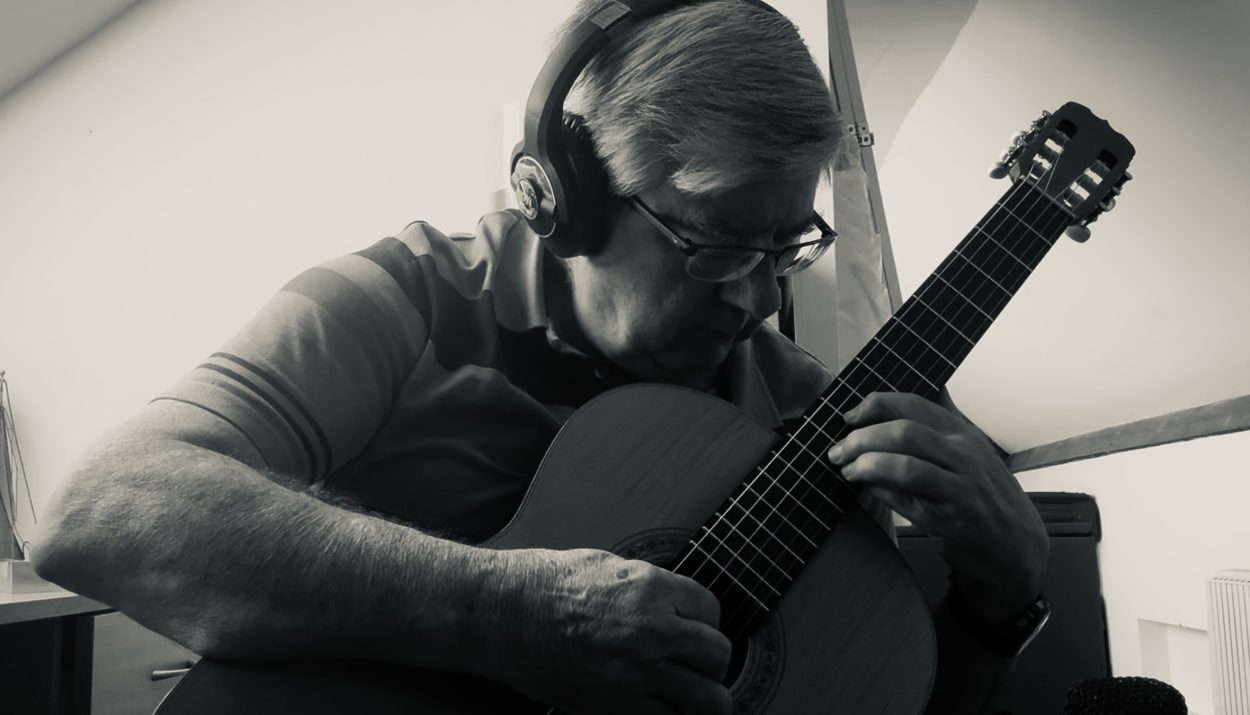

Martin Howard is the kind of guitarist who does not just play notes. He builds rooms with them. He has the calm hand of a classical player and the instinct of a blues and rock musician who knows when to hold back and when to let the music speak with force. In “Hidden Andalucia,” he turns all of that experience into one carefully shaped solo guitar piece that feels old and new, intimate and bold.
This track is built on a striking idea: the opening and closing sections look toward John Dowland, with a loose Elizabethan grace, while the middle section opens the door to flamenco themes. That contrast gives the piece its soul. It is not just a blend of styles for effect. It feels like a real journey, as if one musical world has crossed a border and found another waiting there. The title itself fits beautifully. “Hidden Andalucia” suggests a place tucked away beneath the surface, and Howard brings that hidden land into view note by note.
His expertise is clear from the first phrase. A guitarist needs more than speed or clean fingering to make this kind of fusion work. They need taste, control, and the confidence to let two traditions share the same space without fighting each other. Howard shows that he understands both languages. The Dowland-inspired sections have a noble, reflective tone, with a sense of space and poise. The flamenco passages add heat, rhythm, and colour, but they never sound pasted on. He lets the piece breathe, so the music can move naturally from one world to the next.
The performance is impressive because it feels human. Howard does not try to show off. He plays like someone who trusts the material. His touch suggests years of discipline but also years of listening. The classical side of his background gives the piece shape and refinement, while his wider work in folk, blues, rock, electric, acoustic, and slide guitar gives it a broader emotional range. Even in a solo setting, his playing carries the feeling of a larger musical life. You can hear a musician who has spent time in many rooms and learned how each one sounds.
His delivery is especially strong in the way he manages mood. The piece does not rush to prove its point. It unfolds. The opening invites the ear, the central section brings motion and tension, and the closing returns with a kind of quiet wisdom. That arc gives “Hidden Andalucia” a real sense of form. The music feels composed, not merely performed. It has direction. It has memory. It leaves an impression of distance travelled.
The production should also be praised. For a solo classical guitar piece, the sound needs to be warm, clear, and close enough to catch the small details without making the instrument feel bare. This kind of music depends on the listener hearing the wood, the string, and the fingerwork as part of the emotional message. The recording appears to respect that balance. Nothing seems overdone. The guitar is given room to speak, and that space helps the style changes feel more vivid. In a piece like this, production is not decoration; it is part of the storytelling. Here, it supports the music rather than competing with it.
As an artist, Martin Howard deserves to be introduced as more than a guitarist with range. He is a musical translator, someone who can move between traditions without losing the heart of either one. His work has the rare gift of sounding thoughtful without becoming distant and expressive without becoming cluttered. In “Hidden Andalucia,” he gives listeners a piece that feels like a secret passed down across centuries, then brought into the present with steady hands and a clear artistic voice.
Listen to “Hidden Andalucia” on Spotify
Subscribe to Martin’s YouTube