
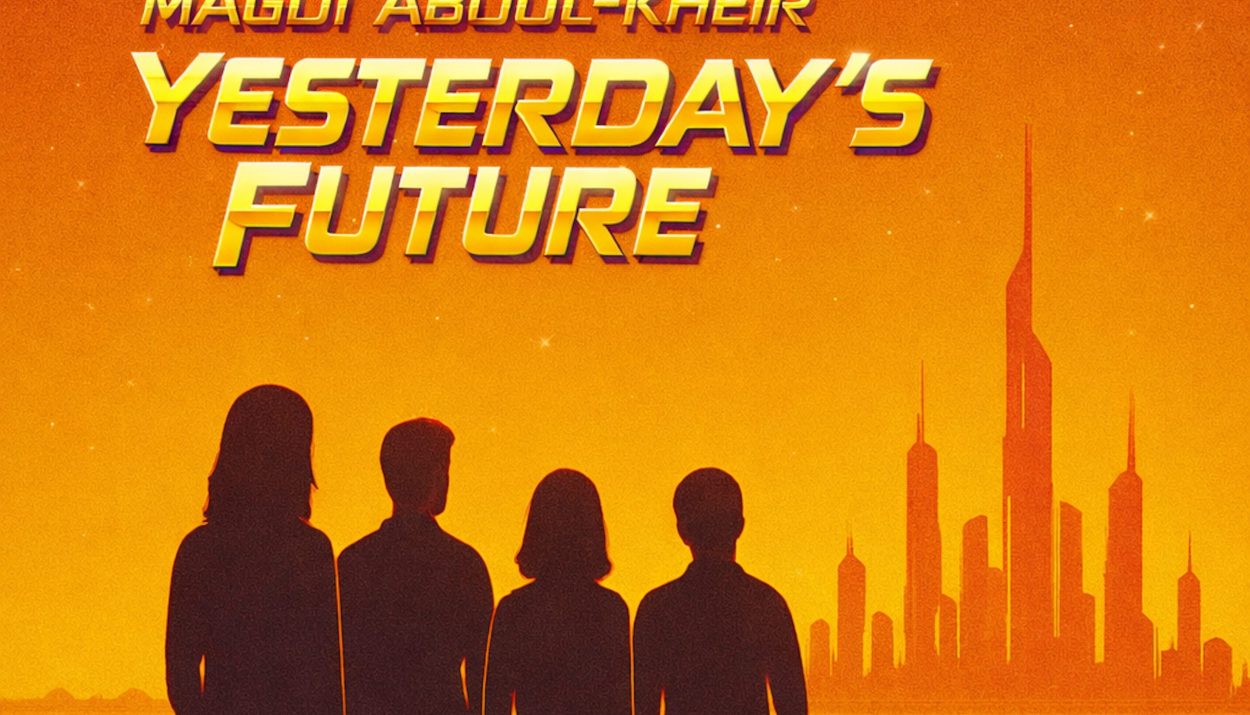

Some albums look back, while others make the past feel futuristic again. “Yesterday’s Future,” the latest instrumental album from Germany-based composer Magdi Aboul-Kheir, belongs to the latter. Rather than paying tribute to the 1980s, it becomes a playful act of time travel—a nine-track journey into an era when the future was imagined through neon lights, synthesizers, electric guitars, blinking machines, and boundless optimism.
Magdi Aboul-Kheir is a composer with remarkably broad musical instincts. A pianist by training, he moves comfortably between minimal music, chamber and orchestral writing, pop, jazz-influenced instrumentals, ambient textures, and vintage electronic sounds. What connects these different styles is his strong belief in melody, atmosphere, and emotional communication. His music never feels like genre experimentation for its own sake; instead, technique serves feeling and imagination.
That approach makes the album engaging. Aboul-Kheir understands that instrumental music can tell stories without words. His melodies have personality, his rhythms create momentum, and his textures create clean environments. Rather than simply recreating an old sound, he captures the excitement behind it—the feeling of a future that once seemed limitless. Let’s see what “Yesterday’s Future” has for us. Keep reading.
“Past Is Calling” opens the album with an appropriate invitation from memory. Its electronic palette immediately establishes the retro-futurist atmosphere, while its melodic construction keeps it from becoming simple pastiche. The track feels like opening an old door and discovering a surprisingly vibrant world on the other side—nostalgic, energetic, and cinematic.
“Machines’ Gym” transforms mechanical repetition into an infectious groove. Its rhythmic patterns suggest gears, circuits, exertion, and constant movement, while the production gives the track a sleek, muscular character. The humor of the concept never overshadows the composition. Aboul-Kheir uses repetition intelligently, introducing subtle changes in texture and emphasis that keep the track evolving.
“Endorphine Wave” delivers a burst of pure exhilaration. Buoyant synths, rhythmic propulsion, and memorable melodic elements create the sensation of being carried forward by a wave. It is energetic without becoming merely functional dance music, thanks largely to Aboul-Kheir’s gift for creating instrumental melodies that remain memorable.
“Through the Neonrain” is one of the album’s most cinematic moments. Its title immediately suggests wet streets, glowing signs, blurred headlights, and futuristic cityscapes. The music creates that atmosphere without relying on excessive effects. Electronic textures establish the scenery while the melody provides the emotional perspective, resulting in a warm, atmospheric piece of futuristic noir.
“Pulsraum” feels like a space constructed from rhythm and vibration. Its central pulse becomes almost architectural, with layers of sound creating movement around the beat. Aboul-Kheir’s skill with texture is especially clear here: every element has a purpose, and the arrangement remains immersive without becoming crowded.
The title track, “Yesterday’s Future,” serves as the album’s central statement. It captures the strange beauty of retro-futurism—the future imagined before the real future arrived. Synthesizers, driving rhythms, guitars, and expansive arrangements combine to create something familiar yet refreshed. The track celebrates the optimism of technological possibility without becoming trapped in nostalgia.
“Abyss of Shadows” introduces a darker atmosphere and gives the album welcome emotional depth. The futuristic world suddenly feels less playful and more mysterious, proving that Aboul-Kheir’s sonic palette can move beyond bright nostalgia. Its darker mood creates contrast, making the surrounding moments of light and energy feel even stronger.
“Sunburst” provides the perfect counterweight. It feels like dawn after the neon night, bringing brightness, energy, and optimism back into the journey. The composition remains uplifting without becoming overly sentimental, demonstrating once again Aboul-Kheir’s ability to combine accessible melodies with carefully constructed arrangements.
Closing with “Life’s Journey” is an especially thoughtful decision. After machines, neon streets, futuristic fantasies, shadows, and movement, the album ultimately becomes something more human. The track broadens the idea of the journey beyond technology and nostalgia, reflecting on where we come from, where we imagined we were going, and what we carry with us.
One of Yesterday’s Future’s greatest achievements is its production philosophy. Aboul-Kheir understands that recreating an era is not the same as copying it. He captures the character of vintage electronic music while keeping the sound alive. Synthesizers and drum machines establish the identity, guitars provide human energy, and strings add emotional and cinematic scale. Every instrument feels chosen for a dramatic purpose.
His control is equally impressive. He understands the musical vocabulary of the styles he explores, but he never overwhelms listeners to demonstrate his knowledge. Instead, he prioritizes communication. The pianist’s sensibility can be heard in the melodies and harmonies, while his broader compositional experience appears in the album’s pacing, structure, contrasts, and layering.
Ultimately, Yesterday’s Future is a celebration of an imagined tomorrow and a reminder of how creative those imagined tomorrows once were. Across nine tracks, Magdi Aboul-Kheir creates a world of glowing synthesizers, accelerating drum machines, roaring guitars, rising strings, exercising robots, neon rain, shadows, and adventure. Yet beneath all the retro imagery lies something timeless: melody.
That is why the album works beyond nostalgia. You do not need to have lived through the 1980s to appreciate it. You need an ear for strong themes, expressive instrumental writing, memorable textures, and music that knows how to have fun. Yesterday’s Future is more than a routine throwback; it is a confident and imaginative meeting point between memory and invention. The past may be calling, but in Magdi Aboul-Kheir’s hands, it still knows how to sound like tomorrow.
Listen to the “Yesterday’s Future” album on Spotify
Follow Magdi Aboul-Kheir here for more information